 By
By 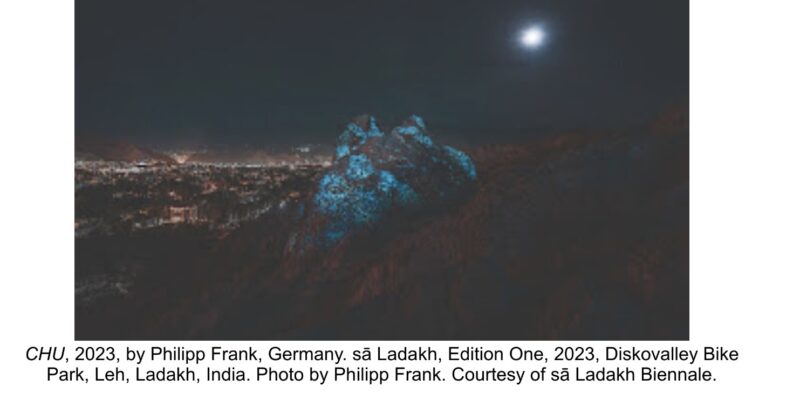
Screenshot
Taking place from 1–10 August 2026, the Biennale is curated by Vishal K Dar, with Tsering Motup Siddho as Associate Curator, and brings together 12 international and Ladakhi artists and artist duos responding to land, ecology and the quiet urgencies of our time.
Positioned as the world’s highest regenerative art biennale at over 3,000 metres, it unfolds as a journey across 230 kilometres and 8 sites along the Leh–Kargil corridor, historically a key node of the Silk Route.
The programme extends to three Special Projects, spanning exhibitions, residencies, workshops and community-led initiatives.
Embracing regeneration as a methodology, the biennale pushes a new model for art responding to climate and ecology
sā Ladakh Biennale presents its inaugural edition, taking place from 1–10 August 2026 across the high-altitude terrains of Ladakh, India. Grounded in the meaning of ‘sā’, ‘soil’ in Ladakhi, the Biennale unfolds across eight sites along the Leh-Kargil corridor, activating villages, learning spaces and open landscapes at over 3,000 metres, and positioning itself as the world’s highest regenerative art biennale.
sā Ladakh Biennale 2026: Signals from Another Star
The 2026 Biennale is guided by Vishal K Dar’s curatorial vision, Signals from Another Star, with Tsering Motup Siddho as Associate Curator. Bringing together 12 international and Ladakhi artists and artist duos from diverse geographies and practices, it takes the form of a field of signals, foregrounding attentive, site-responsive practices that engage with the land, its memory, weather, trade routes, communities and histories. In doing so, it invites new ways of seeing and understanding these conditions, while asking how art might take responsibility for climate through close engagement with place.
Participating artists include Agnieszka Kurant (Poland), Amrit Kakri (Nepal), Anna Jermolaewa (Russia / Austria), Arunima Dazess Wangchuk (Leh, Ladakh), Avantika Bawa (USA), Ayan Biswas (Likir, Ladakh), Chemat Dorjey (Sakti, Leh, Ladakh), David Soin Tappeser (Germany), Denizay Apusoglu (Switzerland), Grazia Toderi (Italy), Himali Singh Soin (India), Jigmet Angmo (Sakti, Leh, Ladakh), Jitish Kallat (India), Jonas Kissling (Switzerland), Peter Kogler (Austria), Shupiwe Chongwe (Australia), Skarma Sonam Tashi (Sapi, Kargil, Ladakh), Stanzin Samphel (Chemday, Leh, Ladakh), Stanzin Tsepel (Rangdum, Zanskar, Ladakh), Stanzin Wangail (Stok, Leh, Ladakh), Tashi Namgial (Skurbuchan, Leh, Ladakh), Tenzin Olden (Shilling-Skit, Zanskar, Ladakh), Tom Mùller (Switzerland), Tundup Dorjay (Igoo, Leh, Ladakh), Urgain Zawa (Igoo, Leh, Ladakh), Zahara Batool (Pashkum, Kargil, Ladakh)
With regeneration as a guiding principle, the Biennale will host residencies, workshops and community-led initiatives, making space for art, ethical engagement with local communities, and urgent issues of global concern.
Special Projects
Beyond the Biennale exhibition, the programme extends to three Special Projects: an exhibition in Leh’s Old Town featuring five Ladakhi artists, reactivating the site as a community-led cultural space; an international collaboration with museum in progress (Austria) as part of the raising flags project, presenting six flags across Biennale sites, including a new work by Ladakhi artist Skarma Sonam Tashi; and an intervention led by Ayan Biswas supported by Quiet Art Movement (India), documenting medicinal plants in Kargil through alternative processes and school workshops, culminating in a biomass-based installation.
Partners
sā Ladakh Biennale 2026 is developed in collaboration with a wide network of partners, including Ladakh Arts and Media Organisation (LAMO), People’s Action Group of Inclusion and Rights Ladakh (PAGIR), Dolkhar, Roots Ladakh, Local Futures Ladakh, the Crashpad, and Unexplored Ladakh.
Cultural exchange includes the German Embassy to India, the Austrian Embassy to India, the Austrian Cultural Forum, the Embassy of Switzerland in India and Bhutan under the initiative Sustainability With a Plus, the Swiss Arts Council-Pro Helvetia and the Royal Enfield Social Mission (India), the Western Australia Government.
Institutional partners include Fremantle Biennale (Australia), Disability in Arts, Disadvantage in Art (Australia), Rubin Museum of Himalayan Art (US), Neekoee Foundation (India), the Gujral Foundation (India), The Ford Family Foundation (US), Portland Institute for Contemporary Art (US), Dharamshala International Film Festival (India), museum in progress (Austria), Quiet Art Movement (India), Good Life X (Sri Lanka), STIRworld (India), and Black Sheep Media House (India).

Comments