 By
By 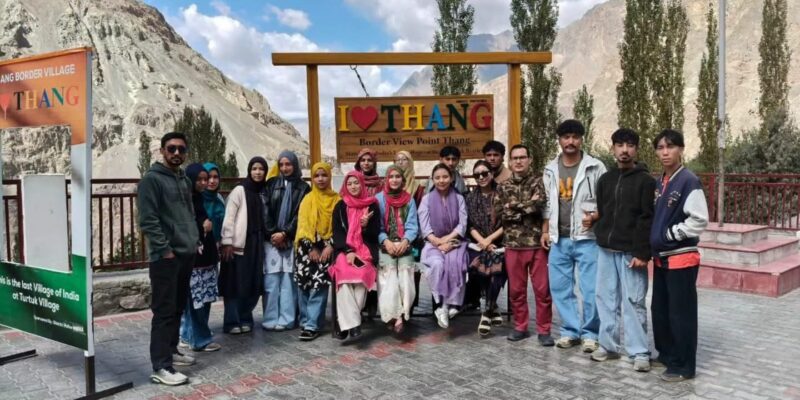
Sankoo, September 21, 2026: Government Degree College, Sankoo, organised a four-day interdisciplinary educational tour to Nubra Valley, Turtuk, Thang, Diskit and Hunder from September 14 to 17, 2026, with the participation of students and faculty from the Departments of History, Political Science, Economics and Sociology.
The tour was designed to provide students with experiential learning by connecting classroom concepts with the historical, political, economic and sociological realities of the region. The journey commenced from Sankoo on September 14, with the group travelling towards Nubra Valley via Khardung La. The journey itself offered students an opportunity to understand the importance of connectivity, infrastructure and transportation in the high-altitude and strategically significant landscape of Ladakh.
On September 15, the students travelled from Diskit to Turtuk, where they undertook a heritage walk. The students visited the Turtuk Heritage House and Museum, traditional houses, the old royal residence/palace and museum, and observed traditional clothing, household objects and other artefacts representing the material culture of the region. The heritage walks also exposed students to the traditional hanging bridge and natural cold-storage system, providing valuable insights into indigenous knowledge, traditional technology and adaptation to the local environment.
A significant aspect of the visit was learning about community participation in heritage preservation, including the role played by local women in managing and maintaining heritage-related initiatives. The interaction provided students of Sociology and Economics with an opportunity to understand women’s participation, community institutions, heritage conservation and livelihood generation.
On September 16, the students proceeded towards Thang, a strategically significant borderland settlement. An interaction with Ghulam Hussain, 73 years provided the students with insights into the historical, political and social realities of the area. The visit enabled students to understand the lived experiences of border communities and the importance of connectivity, administration and public infrastructure in remote regions.
The students also visited Diskit Monastery and the Chamba/Maitreya Buddha statue, where they explored the historical and cultural significance of Buddhist institutions and religious heritage in Ladakh. The visit to the Hunder sand dunes further provided an opportunity to discuss the relationship between environment, tourism and the local economy.
The visit to Zimskhang, associated with the royal residential tradition, enabled students to explore the relationship between political authority, architecture and historical memory. The tour concluded with exposure to the Artisans’ Bazaar, where students observed the role of handicrafts, traditional skills, tourism and local entrepreneurship in the regional economy.
Speaking about the educational significance of the tour, the faculty emphasized that such field-based programmes enable students to move beyond textbook learning and understand how history, politics, economy and society interact in shaping a region. The tour particularly highlighted the importance of heritage conservation, sustainable tourism, traditional knowledge, women’s participation and community-based development. The programme concluded with the shared objective of encouraging students to approach the study of society and its past through direct observation, interaction and interdisciplinary enquiry.

Comments