 By
By 
New Delhi, December 4 — In a major shift for healthcare education in India, the National Commission for Allied and Healthcare Professions (NCAHP) has announced that the National Eligibility-cum-Entrance Test (NEET) will be compulsory for admission to several undergraduate allied and healthcare programmes starting from the 2026-27 academic year.
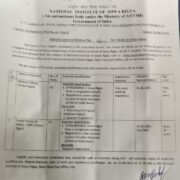
According to the latest notification issued in November, students aspiring to pursue select undergraduate Allied & Healthcare courses after Class 12 will now be required to qualify NEET, in addition to meeting the existing course-specific eligibility criteria. The decision marks a move towards standardising admission processes across medical-related fields nationwide.
13 New Curricula Finalised
NCAHP confirmed that it has already notified 13 curricula for undergraduate and postgraduate Allied & Healthcare programmes. These structured curricula—developed under the NCAHP Act, 2021—include detailed eligibility requirements, academic standards, and training guidelines for each discipline.
Most of these newly notified curricula explicitly list NEET qualification as a mandatory entry requirement. The commission also stated that additional curricula will be released soon as part of its ongoing reforms in healthcare education.
Courses Expected to Fall Under NEET Requirement
The NEET mandate is expected to apply to major allied and healthcare programmes such as:
Physiotherapy (BPT) Optometry Medical Laboratory Technology Radiology & Imaging Technology Dialysis Technology Nutrition & Dietetics Occupational Therapy, and other therapy/technology-based programmes
These are part of the rapidly expanding Allied & Healthcare sector, which has been formally recognised under the 2021 Act.
Goal: Standardisation & Quality Assurance
NCAHP stated that the introduction of NEET in allied courses aims to:
ensure uniform admission standards across India prevent unregulated or low-quality institutions improve the scientific foundation of students entering healthcare disciplines align admission processes with those used in MBBS and BDS programmes
The commission believes that a single national entrance exam will enhance the credibility and professionalism of Allied & Healthcare careers.
“Paramedical” Term to Be Discontinued
In a related reform, NCAHP has recommended the discontinuation of the term “paramedical”, replacing it with the more accurate and globally accepted term “Allied and Healthcare Professions.”
This change reflects the growing scope, independence, and recognition of roles in physiotherapy, imaging, lab sciences, optometry, and other healthcare domains.
Implementation From 2026-27
The NEET requirement and new curricula will be enforced starting the 2026-27 admission cycle, giving schools, colleges, and aspiring students adequate time to prepare for the shift.
Bottom Line
Beginning 2026-27, NEET will no longer be limited to MBBS, BDS, and traditional medical degrees. It will also become a mandatory gateway for several Allied & Healthcare undergraduate courses, reshaping the future of healthcare education in India.








Comments